

The United Nations Office at Geneva
Multimedia Newsroom
Press Conferences | IFRC , OCHA , OHCHR , UNCTAD , UNHCR , UNOG , WHO , WMO
UN Geneva Press Briefing - 28 October 2025
UN GENEVA PRESS BRIEFING
28 October 2025
Hurricane Melissa
Anne-Claire Fontan, World Meteorological Organization (WMO) tropical cyclone specialist, stated that the massive hurricane was heading towards Jamaica and was expected to have a severe impact on the country in the coming hours. There would be a lot of rainfall, leading to catastrophic flash floodings and numerous landslides. Peak storm surge heights could reach three to four meters above ground level, near and to the east of where the center of Melissa made landfall. This storm surge would be accompanied by large and destructive waves. Since hurricane Gilbert in 1998, Jamaica had not been impacted by such a powerful hurricane. Melissa would also affect Cuba, the Bahamas, Haiti, and the Dominican Republic, bringing high levels of rain and strong winds.
Necephor Mghendi, Head of Delegation of the International Federation of Red Cross and Red Crescent Societies (IFRC) for English and Dutch Speaking Caribbean, speaking from Port of Spain, said that the category five hurricane was threatening Jamaica today, putting over one million people at risk. The coastal communities had already been under strain from previous events, including tropical storm Barry [late June 2025], he explained. The indicated total of rainfall could be as many as three times higher than during Barry, which could cut essential services for days, if not weeks. The humanitarian threat was thus imminent. Women, children, the elderly and people with disabilities were particularly vulnerable, especially in coastal communities.
The Jamaican Red Cross had mobilized in preparation for hurricane Melissa, helping with early warning, evacuation and distribution of prepositioned items. Some 400 volunteers were now active on the ground, making sure that people get out of the harm’s way. Local knowledge and community trust were key elements in a crisis like this, when every minute counted. Some CHF 60,000 had been mobilized through the IFRC network to help with the early response. Roads would be tested, floods would be massive, and communication networks were expected to be affected as well. Finally, Mr. Mghendi stressed that there would be a need for international solidarity, and the IFRC was doing its part, standing ready to reinforce and support Jamaica’s own response.
Responding to questions from the media, Mr. Mghendi, for the IFRC, explained that the authorities had prepared over 800 shelters. The main priority was to get the people out of harm’s way, and it was believed that most of them had indeed move away. On preparedness in Cuba, Mr. Mghendi said that the Cuban Red Cross volunteers had been disseminating early warning messages, and prepositioned goods could reach the island quickly. The Red Cross also had teams ready to help the Bahamas, he said. Jens Laerke, for the Office for the Coordination of Humanitarian Affairs (OCHA), added that OCHA had activated the so-called anticipatory action framework and released USD 4 million from the Central Emergency Response Fund (CERF) to help Cuba and Haiti. Mr. Mghendi hoped that the global community would come together to respond and assist those affected by hurricane Melissa. Some 1.5 million people might be directly impacted, but the entire population of Jamaica would feel the effects one way or another.
Ms. Fontan, for the WMO, answering another question, said that for Jamaica this would be the strongest storm of this century. Mr. Laerke said that the first order or priority was saving lives and getting people out of harm’s way, to be followed by providing food, safe drinking water, shelter, and medical care. Longer-term support and reconstruction would eventually be needed after a proper assessment, where the Government of Jamaica would take the lead, with the support of the UN. Tommaso Della Longa, also for the IFRC, added that mental and psychosocial support would also be critical in the hurricane’s aftermath, along with restoring family links.
Escalating violence in El Fasher
Eujin Byun, for the United Nations Refugee Agency (UNHCR), stated that the situation in Sudan had deteriorated even further, and UNHCR was deeply concerned about the escalating violence in El Fasher, forcing many to leave, while many others remained stuck in the city.
Jacqueline Wilma Parlevliet, United Nations Refugee Agency (UNHCR) Head of Sub-Office in Sudan, speaking from Amsterdam, said that 650,000 IDPs had already been hosted in Tawila, and in recent days another 25,000 had arrived. Testimonies from those arriving in Tawila, 50 kilometres from El Fasher, suggested that what was already an alarming humanitarian and protection crisis was spiraling rapidly. Indiscriminate violence was taking place in El Fasher, and there were reports of people with disabilities being executed as they could not flee. Protection needs were immense, with constant violations of international humanitarian law and international human rights law. There were examples of looting, extortion, rape, and recruitment of children into armed forces. The overall situation when it came to the protection of civilians was disastrous. UNHCR focused on protection and assistance to individuals and groups. This was first and foremost a protection crisis, emphasized Ms. Parlevliet. The massive destruction of public infrastructure and people’s private property was happening at the scale not seen before.
In North Kordofan, similar patterns of violence and human rights violations had been reported by survivors, following the recent fall of the town of Bara, resulting in further displacement of thousands within the state. UNHCR was concerned about a possible siege of the town of El Obeid, which was hosting tens of thousands of internally displaced Sudanese, which would further exacerbate humanitarian needs in the region.
Ceasefire was needed immediately, along with humanitarian corridors, stressed Ms. Parlevliet. Many civilians were left in El Fasher, because it was too dangerous or they were too weak to move, following the 500 days of siege of the city. In Tawila, the humanitarian sector was overwhelmed, and much more support was needed to assist those who had fled the violence.
More details are available here.
Rolando Gómez, for the United Nations Information Service (UNIS), read from a statement shared with the media early today, in which the Secretary-General expressed grave concern by the recent military escalation in El Fasher. The Secretary-General strongly condemned reports of violations of international humanitarian law and violations and abuses of human rights in El Fasher, including indiscriminate attacks and targeting of civilians and civilian infrastructure. He reiterated his call for an immediate cessation of hostilities, urging the Sudanese Armed Forces and the Rapid Support Forces to immediately engage with his Personal Envoy for the Sudan, Ramtane Lamamra, and take swift, tangible steps toward a negotiated settlement.
Answering to questions, Ms. Parlevliet said that the UN had maintained lines of communication with all parties to the conflict. All parties had committed to protecting civilians, and they ought to be held to account in this regard. The UN had repeatedly asked for humanitarian pauses and safe passage to deliver humanitarian aid, but the UN had no access at all to people in El Fasher.
Seif Magango, for the Office of the High Commissioner for Human Rights (OHCHR), speaking from Nairobi, said that the OHCHR was aware of reports of ethnically targeted summary executions, but was not able to confirm the figures. While it was difficult to assert how many civilians remained in El Fasher, there could be as many as 260,000 people there, said Ms. Parlevliet responding to another question. Access for humanitarians was of paramount importance, stressed Tommaso Della Longa, for the International Federation of Red Cross and Red Crescent Societies (IFRC), reminding that the Sudanese Red Crescent had lost nine staff. Christian Lindmeier, for the World Health Organization (WHO), said that from 1 January to 30 September, over 31,400 children had been admitted for treatment of malnutrition in stabilization centres in Sudan. Some 3.7 million people were believed to need nutrition response in 2025.
Shutdown of telecommunications in Afghanistan
Jeremy Laurence, for the Office of the High Commissioner for Human Rights (OHCHR), informed that the OHCHR and the UN Assistance Mission in Afghanistan had just published a briefing paper on the serious and far-reaching human rights impacts of previous month’s telecommunications shutdowns in Afghanistan, a measure which compounded the array of difficulties already faced by the population. From its health systems to the banking sector and everyday operations of small businesses, the people of Afghanistan were heavily reliant on telecommunications systems to access essential services. The new paper was based on more than 100 interviews in the aftermath of the 48-hour nationwide shutdown implemented by the de facto authorities between 29 September and 1 October.
Among the human rights impacts documented were delayed or no access to healthcare and emergency services; disruption of humanitarian operations; exacerbation of existing discriminatory restrictions on women and girls; infringement on people’s daily and family lives due to the inability to contact others; and disruption of the conduct of business and banking. Women and girls in Afghanistan had already been subjected to the most draconian restrictions. Women interviewed had shared their experiences of how their lives had become even more difficult during the shutdown. For example, some women had been unable to contact their male guardians, or mahrams, during the shutdown.
Online learning remained the only avenue left for many Afghan women and girls to receive an education, because of the de facto authorities’ ban on women and girls continuing any education beyond the sixth grade. Furthermore, healthcare workers spoke about preventable deaths which occurred because of the shutdown. Humanitarian workers, for their part, said that the shutdown seriously disrupted their work and delayed the provision of vital support to the population.
The briefing paper can be accessed here, while the press release is here.
ASEAN’s declaration on the right to a safe, clean and healthy environment
Jeremy Laurence, for the Office of the High Commissioner for Human Rights (OHCHR), welcomed the adoption by ASEAN of a landmark regional declaration on the right to a healthy environment. The ASEAN Declaration on the Right to a Safe, Clean, Healthy and Sustainable Environment marked a vital step forward as the latest regional affirmation of the right to a healthy environment across Southeast Asia. The High Commissioner for Human Rights, Volker Türk, called on ASEAN States to build on the declaration to ensure coordinated leadership and timely action toward addressing transboundary environmental harms.
Full statement is available here.
Rolando Gómez, for the United Nations Information Service (UNIS), reminded that the Secretary-General had been in Kuala Lumpur for the ASEAN-UN Summit, and his remarks had been shared.
Lebanon
Replying to a question, Jeremy Laurence, for the Office of the High Commissioner for Human Rights (OHCHR), said that at least 111 civilians in Lebanon were verified to have been killed by Israel since the ceasefire, while over 85,000 civilians remained displaced. All efforts ought to be made to ensure that the ceasefire remain in place. Protection of civilians was paramount.
Announcements
Rolando Gómez, for the United Nations Information Service (UNIS) informed that the Expert Mechanism on the Right to Development was continuing today its 12th session. Today, the Mechanism would discuss the following topics: 1. How and what kind of participation is needed for improving the well-being of individuals and people; 2. The impact of tariffs on the realization of human rights, including the right to development; and 3. Creative industries and the right to development.
He further informed that the Social Forum would hold its 2025 session in the Assembly Hall on 30 and 31 October. The theme of the Forum was “The contribution of education to the respect, promotion, protection and fulfilment of all human rights for all”. The High Commissioner for Human Rights would address the Forum at the opening meeting. The Forum would then hold a keynote panel on the importance of education in the realization of human rights, before holding panels on several different subjects.
***
HURRICANE MELISSA
- WMO Anne-Claire Fontan, WMO tropical cyclone specialist (Zoom)
- IFRC Tommaso Della Longa (PR) with Necephor Mghendi, IFRC Head of Delegation for English and Dutch Speaking Caribbean (From Port of Spain in Trinidad and Tobago)
- OCHA Jens Laerke (PR)
OTHER TOPICS
- UNHCR Eujin Byun (PR) with Jacqueline Wilma Parlevliet, UNHCR’s Head of Sub-Office in Sudan (From Amsterdam)
Escalating violence in Sudan’s El Fasher forces thousands to flee - OHCHR Jeremy Laurence (PR)
Afghanistan telecoms shutdown - human rights impact
OHCHR Seif Magango (Zoom)
UNCTAD Catherine Huissoud (PR)
WHO Christian Lindmeier (Zoom)
Similar Stories
1
1
1
Press Conferences | OCHA , UN WOMEN , UNHCR , WFP , WHO , WTO , UNEP
OCHA – $160M CERF allocation to 12 underfunded crises; UNHCR – 5.8M refugee children remain out of school amid funding cuts; UN Women – Middle East escalation and food security among women/girls; WHO – Gaza supplies and overall situation; WFP – Yemen food insecurity and impact on global hunger ; UNEP - First International Conference of the Global Framework on Chemicals in Geneva | 16-20 November 2026
1
1
1
Press Conferences | UNHCR , WHO
Yemen's health system nears collapse amid conflict, causing rising casualties and medicine shortages.
1
1
1
Press Conferences | HRC
Update by the Expert Mechanism to Advance Racial Justice and Equality in Law Enforcement
1
1
1
Press Conferences | WIPO , WHO , UNICEF , UNHCR , IOM , WFP , FAO
WIPO Global Innovation Index 2026 launch and press conference, WHO Composition of influenza vaccines for the 2027 Southern Hemisphere flu season, UNICEF Yemen hunger and malnutrition; UNHCR Sudan displacement into Chad; IOM Ebola and population movements in DRC; WFP emergency food assistance in Nepal; and FAO food loss and waste.
2
1
2
Press Conferences | UNCTAD
Gaza reconstruction needs reach $71.5 billion as Palestinian economy and public finances face severe strain. Latest UNCTAD report documents the loss of decades of development gains, economic collapse in Gaza and tightening economic constraints in the West Bank.
The report identifies three immediate priorities: transferring withheld Palestinian revenues, safeguarding the banking system and aligning reconstruction support with the documented scale of damage and economic losses.
1
1
1
Press Conferences | HRC
Press conference on the situation of human rights in Nicaragua by the UN Group of Human Rights Experts
1
1
1
Press Conferences | ITU , UNHCR , WHO , WMO
YEMEN - UNHCR: Escalating conflict in Yemen could fuel more displacement, refugee movement
CLIMATE - WHO / WMO: Health and Climate impact of El Niño
1
1
1
Press Conferences | HRC , OHCHR
Mariana Katzarova discusses human rights in Russia as a UN Special Rapporteur.
1
1
1
Press Conferences | IOM , OHCHR , UN WOMEN , UNFPA , UNHCR , UNOPS , WHO
UN Geneva briefing: Yemen crisis worsens, urgent aid needed across multiple sectors.
1
1
1
Press Conferences | HRC
Press conference on the latest report of the Independent International Fact-Finding Mission on the Bolivarian Republic of Venezuela to the UN Human Rights Council
1
1
1
Press Conferences | OHCHR
Victims Still Waiting: A Global Briefing on Transitional Justice Around the World
2
1
2
Edited News , Press Conferences | WMO
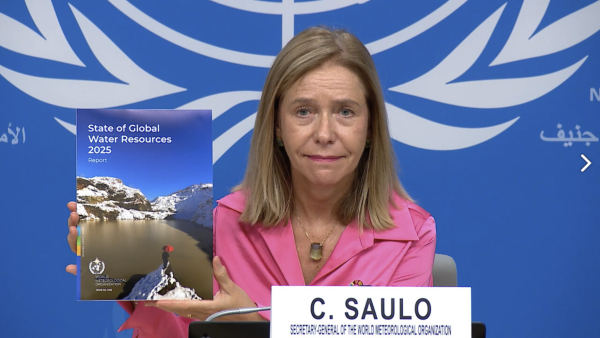
As world’s water reserves change, countries must prepare for a new reality: WMO
New data showing that rivers were at their lowest level for decades last year provides further evidence that the climate crisis is real and countries must act immediately to protect themselves from the increasing threat to communities and livelihoods, the UN World Meteorological Organization (WMO) said on Thursday.
The key findings from WMO’s State of Global Water Resources 2025 report covering the hydrological cycle and extreme events in the five-year period to last year:
- 2025 was one of driest years for river discharge in 35 years
- Past seven years have seen abnorfmal river flows
- Water storage on Earth’s land surface has decreased in past decade
- Widespread glacier loss across all regions for fourth consecutive year
- Asia and Africa are regions most affected by water-related disasters
- Water data availability has improved, but gaps remain in hard-hit areas
Highlighting the long-term decline in the Earth’s freshwater storage and glacier melt, WMO Secretary-General Celeste Saulo explained that the planet’s water reserves used to act as a planetary “savings account” that absorbed the occasional dry season, avoiding a water crisis. “One of the central stories of the 2025 report is what is happening to that savings account? And the simple answer is that we are depleting it,” she told journalists in Geneva.
Groundwater reserves are equally stretched and have been in decline since 2014, WMO’s report states, with nearly two-thirds of monitored wells worldwide showing levels lower than the historical norm and indicating a shift “further toward deficit…not recovery”.
“At the same time, we are seeing more water-related disasters,” Ms. Saulo said, while also stressing that the currently strengthening El Niño “will increase the risk of drought in some areas, and flooding in others”.
Glaciers disappearing
In 2025, for the fourth consecutive year, every major glaciated region on Earth lost ice mass, leading to short-term hazards including floods and long-term water insecurity, according to WMO.
Responding to a question about whether the changing global water cycle might have contributed to the deadly Nepal-China flooding disaster, Ms. Saulo explained that melting ice and rock was just one factor in the chain of events that ultimately sent a massive and deadly wall of water and debris downstream on 26 August, killing at least 1,367 people.
“You asked if it could happen again? Absolutely; the problem in this region is that there’s 63,700 glaciers at the last count,” she told a Press Conference in Geneva. “Even if you’re looking with remote sensing with satellites at these glaciers, you might see some faults, you might see some slight shifting, that does not mean necessarily catastrophic collapse. So, in order to plan for this, it’s very, very difficult. But the international community is looking very hard at ways in which we can bring people together to solve some of these monitoring issues.”
Data indicates that glaciers shrank between 2023 and 2025 with cumulative losses of 1,400 gigatonnes of water – or about one third of annual fresh water needs.
Every major glacier region on Earth lost ice for the fourth consecutive year.
“All 19 glacier regions around the globe lost ice; in Central Asia, Iceland, the Russian Arctic and western Canada and the United States, it was among the three worst years on record,” said Wayne Jenkinson, WMO’s Director of Hydrology and Cryosphere.
Some regions with smaller glaciers such as Central Europe, the Caucasus, the western Canada and the United States may already have reached “peak water”, Mr. Jenkinson warned.
“After this point, the glacier gives less meltwater each year simply because there is less ice left to melt. That matters for every community downstream that relies on water during hot, dry summers,” he explained.
Narelle van der Wel, WMO’s Head of Cryosphere Monitoring, Predictions and Services, stressed that while some further glacier loss is unavoidable, the eventual scale of the decline is not predetermined.
“Some glacier loss is inevitable, but total loss of glaciers is not yet inevitable,” she said, pointing to emissions reductions as central to limiting future losses.
Preparing for moving baselines
The report does not attribute every observed change to climate change alone. WMO says pressure on water resources and natural variability also contribute.
Mr. Jenkinson said governments need to prepare for “moving baselines” as historical patterns become less reliable.
“The situation 30 years ago is not where we are today,” he said. Countries, he added, need to prepare “for those changes that have really already arrived”.
ends